
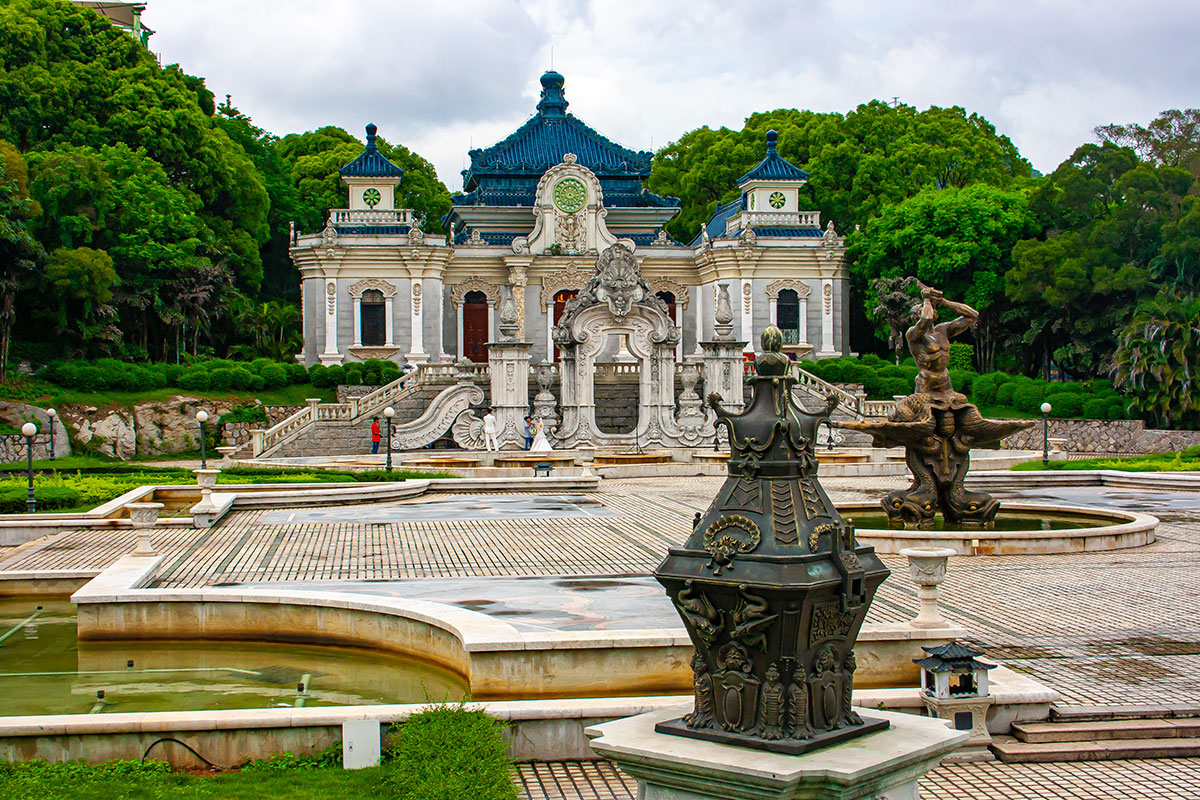
Not every great story in Beijing has a happy ending — and the Yuanmingyuan Gardens are proof of that. Once considered one of the most breathtaking imperial gardens ever built, today it exists mostly as ruins. But those ruins tell an unforgettable story about beauty, ambition, and loss.
## A Garden 150 Years in the Making
Construction on Yuanmingyuan — whose name means “Garden of Perfect Brightness” — began in 1707, during the reign of Emperor Kangxi. What started as a single garden eventually grew into three: Yuanmingyuan proper, the Garden of Eternal Spring (Changchunyuan), and the Elegant Spring Garden (Qichunyuan). Together, they covered a massive 350 hectares and featured nearly 100 distinct scenic areas.
This wasn’t a project completed by one emperor and left alone — it evolved across five Qing emperors over more than 150 years: Yongzheng, Qianlong, Jiaqing, Daoguang, and Xianfeng, each adding their own touches. Countless skilled artisans worked on the grounds, and the imperial court poured what would today be an almost unimaginable fortune into its construction.
The result was spectacular enough that its fame spread all the way to Europe, where it earned the nickname “the garden of gardens” — considered by many to be the finest example of garden design in the world.
## A Devastating Turning Point
Sadly, Yuanmingyuan’s story takes a tragic turn in October 1860. During the Second Opium War, Anglo-French forces looted and then burned the palace to the ground — a retaliatory act following the mistreatment of a negotiating delegation that had traveled to Beijing to discuss a truce. Some historical accounts suggest that even the soldiers carrying out the destruction did so with regret, recognizing the scale of what was being lost.
It’s one of the more heartbreaking chapters in Chinese history, and the effects are still visible today — most of the garden’s original structures never recovered.
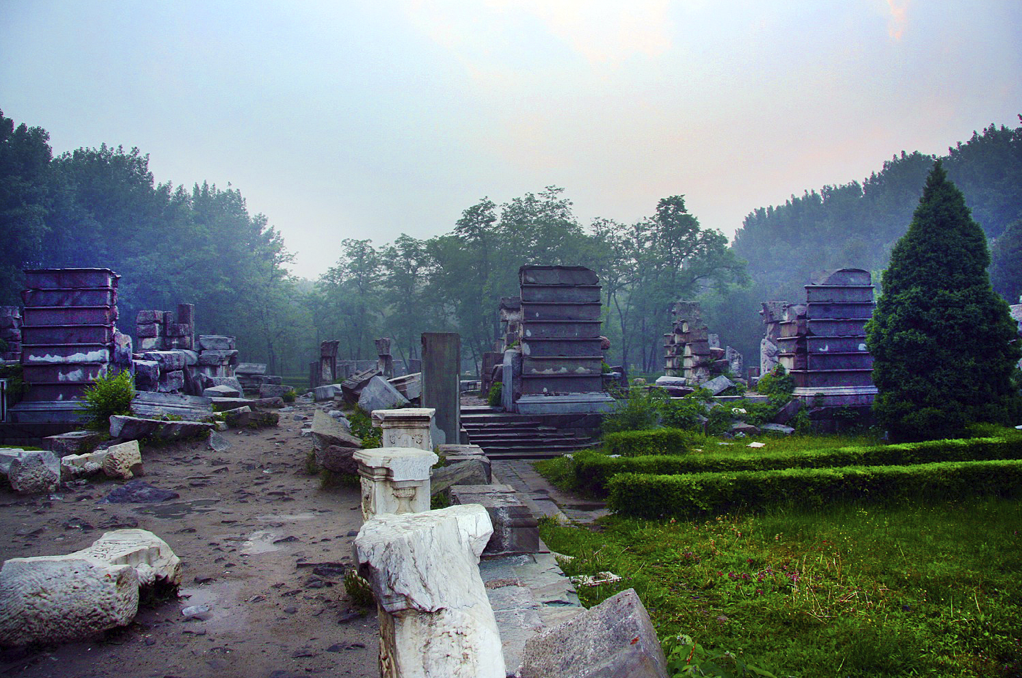
## From Ruins to Remembrance
After the founding of the People’s Republic of China, the government began taking real steps to protect what remained of Yuanmingyuan. The site was officially designated as parkland and recognized as a major cultural heritage site. Over the years, restoration work has slowly brought parts of the landscape back to life — hills and waterways have been repaired, thousands of trees now grow lush and green throughout the grounds, and seasonal flowers bloom in vivid color. A handful of garden structures have even been rebuilt to reflect their former glory.
Even so, much of Yuanmingyuan remains intentionally left as ruins — a deliberate choice to preserve the memory of what happened here. Today, visitors can wander through what’s known as the Yuanmingyuan Ruins Park, located in northwest Beijing, not far from the Summer Palace.
Interestingly, this history has sparked an ongoing debate: should the garden be fully restored, or left as it is? Some historians argue the ruins themselves are historically significant and deserve to remain as a lasting reminder. Others point out that the cost of a full reconstruction would be enormous — and perhaps beside the point.
## The Xiyanglou: Europe Meets China
Among the most fascinating parts of Yuanmingyuan is an area known as Xiyanglou, or the “European Buildings” — a European-style section built in the northern part of the Garden of Eternal Spring. Spanning 70,000 square meters, this section featured more than 10 unique buildings and courtyards with names like Xieqiqu, Fangwaiguan, and Dashuifa.
Planning for Xiyanglou began in 1747 under Emperor Qianlong, with construction largely finished by 1759. What makes it especially unique is *who* designed it: the Italian painter Giuseppe Castiglione and the French missionary Michel Benoist guided the architectural vision, blending European Baroque style and French-inspired landscaping with traditional Chinese building techniques — all constructed by Chinese craftsmen. It was a genuinely global collaboration, centuries before that kind of cross-cultural design became common.
The Qing court was proud enough of Xiyanglou to commission a set of 20 detailed architectural engravings, drawn by court painter Yi Lantai and carved by the Imperial Workshop’s craftsmen — giving us a lasting record of just how remarkable these buildings once were.
When the 1860 fires swept through Yuanmingyuan, the Xiyanglou buildings actually fared better than most of the garden, since they were built largely from stone rather than wood. Their weathered remains stood for more than a century afterward, quietly bearing witness to that painful chapter of history.
## A Few Standout Structures
**Xieqiqu** was the very first European-style building completed at Yuanmingyuan, finished in 1751. It was an elegant three-story structure, with a curved corridor connecting it to two octagonal side buildings, and it once served as a space where musicians played both Chinese and Western music. Remarkably, the fountain that originally stood in front of the building was rediscovered decades later at Beijing University and was returned to its original spot in 1987.
**Guanshuifa**, completed in 1759, was where Qing emperors would sit and enjoy the view of the nearby Dashuifa Fountain. It featured an imperial throne set against five large carved stone screens depicting European military flags, armor, and swords — flanked on either side by elegant white marble pagodas.
## Why Yuanmingyuan Still Matters
Today, Yuanmingyuan isn’t just a park — it’s a place of memory. Walking among its restored gardens and weathered ruins offers a rare kind of experience: a chance to see both the extraordinary heights of imperial craftsmanship and the very real cost of conflict, side by side. It’s a reminder that history isn’t always about what still stands, but sometimes about what was lost — and why we choose to remember it.